
What is a video recorder at a pack station and how is it different from CCTV?

A video recorder at a pack station is a purpose-built camera system that records the packing process and links every recording to an order ID. It’s not a security camera watching the entire warehouse. It captures what goes into the box and against which order so the footage is searchable and usable when a customer dispute or audit comes up.

CCTV does something different. It covers the whole area. A packing recorder covers only the packing station. That distinction sounds small, but it’s the entire reason warehouses and 3PLs are adding a dedicated video recorder at a pack station on top of their existing camera infrastructure.

What does a video recorder at a pack station do?

A video recorder at a pack station records the packing activity at each station and ties that footage to the order being packed. The recording starts when the packer opens or scans the order, captures the items being placed into the box, and stops when the order is sealed.

The footage isn’t stored as a generic clip. A packing video capture system indexes it against the order ID and gives a timestamped video proof of the packing. That’s what makes it retrievable. When a complaint comes in for order #18452, someone can search that order number and pull the exact recording without the need to scroll through hours of warehouse footage trying to estimate when that order was packed.

Beyond retrieval, a packing station camera also captures the things that matter most during a dispute:
  • Which SKU was placed into the box
  • The quantity of items packed
  • Whether accessories, inserts, or small components were included
  • The exact sequence in which items were packed
  • Any correction or exception handled before the box was sealed
That level of detail isn’t available from a shipment tracking number or a WMS status update. It only exists if the recording at packstation is set up to capture it.

How is pack station video recording different from CCTV?

CCTV is designed for security and area coverage. A video recorder at a pack station is designed for order-level proof. The two systems are built for completely different purposes, and that shows up in every part of how they work.
Factor General CCTV Video Recorder at Pack Station
Primary purpose
Security monitoring, area surveillance
Order-level packing proof and evidence capture
What it records
Footage of the area and people moving through it
Specific packing activity tied to the order ID
How footage is indexed
By date, time, and camera location
By order ID
SKU visibility
Labels often unreadable from camera distance
Positioned to capture item labels and barcode scans
Order ID linkage
Not connected to any order ID
Every clip is tagged to the order being packed
Search after a complaint
Manual: Search through hours of footage
Instant: search by order ID, pull the clip
Useful for disputes?
Rarely. Footage doesn’t show order-level detail
Yes. Footage shows exactly what was packed and when
There’s also the placement issue. A typical CCTV camera is mounted high and at a wide angle, covering the room. A packing station camera is positioned over the bench, framed to capture the items on the table, the label on the product, and the order on the screen. IP camera proof capture only works when the camera can actually see what’s being packed. General CCTV usually can’t.

What should a pack station camera capture?

Placement and framing determine whether footage is useful or not. A packing station camera should be positioned to capture the packing bench directly.

Specifically, a well-positioned video recorder at a pack station should capture:
  1. The barcode scan or order ID entry that starts the recording
  2. The items being placed into the box with the labels and packaging visible
  3. The quantity of each item as it goes in
  4. Small accessories, inserts, or components that are easy to miss
  5. Any correction or re-pack before the box is sealed
  6. The sealed box and label before it moves to dispatch
A warehouse packing camera system that misses any of these produces footage that looks comprehensive but isn’t useful during a dispute. The frame needs to be tight enough to read a label, not just show that a box was packed.

Why does order-linked video matter?

Order-linked footage is what makes packing video useful after the fact. A recording that can’t be matched to an order is just video. A recording tied to order ID, packer, station, and timestamp is evidence.
Here’s the practical difference. A customer claims an item was missing. The support team needs to know what was packed. Without order-linked footage, the investigation goes to the warehouse team, who check notes, ask the packer, review what they can find. That takes time and rarely produces a clear answer.
With order-linked footage from a video recorder at a pack station, the support team searches the order ID and pulls the recording. They can see what was packed, in what quantity, before the box was sealed. The investigation takes minutes.
Order-linked video also matters for QA beyond individual disputes. When operations can review packing footage by order or by packer, patterns become visible:
  • Which SKUs are getting mixed up or packed incorrectly
  • Where quantity errors happen regularly
  • Whether bundle or kit instructions are being followed at the bench
  • How new packers are performing across their first weeks

That visibility is what turns a packing video recorder from a reactive tool into something that actually improves the packing process over time.

Does recording at a pack station change the packing workflow?

A packstation video capture system that requires packers to do anything extra. The recording is triggered by something the packer already does: scanning the order ID or opening the order on the packing screen.
From there, the video recorder at a pack station runs in the background. The packer works normally. The packing video recorder captures the session. When the order is sealed or the next order is opened, the clip is saved and indexed automatically against the order record.
Packers don’t need to manage the recordings. Operations and support access footage on cloud when they need it by order ID. The workflow stays unchanged. But now, the process generates proof.

Where does vAudit fit in your pack station?
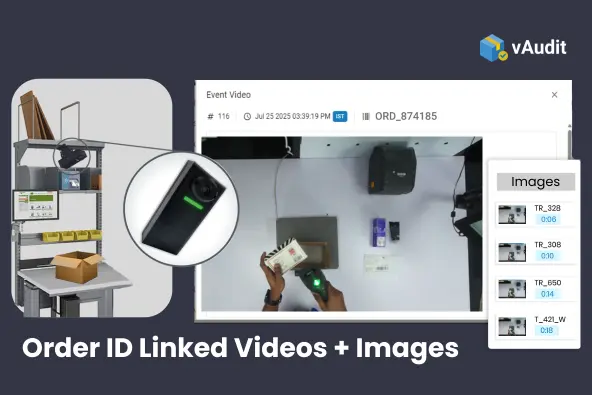
vAudit Video Recorder At Pack Station
vAudit is a video recorder at a pack station built for warehouses, 3PLs, and ecommerce brands.

Every recording is linked to the order ID and stored in the cloud. Support teams can search footage by order number and retrieve the clip in seconds. The vAudit Video Logger handles the indexing automatically. There is no need for manual tagging or digging through CCTV footage.

vAudit works alongside your existing WMS and OMS. It doesn’t change the order flow or slow the packing process. It adds the one thing those systems don’t provide: visual proof of what was actually packed.

Why should warehouses adopt video recorder at their pack station?

A video recorder at a pack station and a CCTV camera are solving different problems. CCTV covers the room. A packing video recorder covers the order. The moment a dispute arrives or an audit is needed, that difference becomes very clear very quickly.
Order-linked footage from a video recorder at a pack station gives warehouses something CCTV can’t: proof that’s searchable, readable, and tied to the specific order in question. Not a continuous camera feed.

Frequently Asked Questions

Can a packstation video capture system run on an existing webcam?

Yes. A software-led packstation video capture system runs on a standard USB webcam connected to an existing desktop. No dedicated hardware is required. For operations that prefer a purpose-built setup, dedicated station hardware with a higher-quality lens is available, but the webcam route works well for small to mid-size operations and is the faster deployment path.
A software-led video recorder at a pack station can be running in under 5 minutes. The desktop app installs on an existing machine, the webcam connects via USB, and the trigger is configured to the order scanning workflow. Dedicated hardware stations take longer due to physical setup and integration configuration, but the software layer is the same.
Yes. Mid-session still image capture is available during an active recording. This is useful when the packer wants to document a specific item condition, a label, or a damage observation without stopping the recording. The still image is attached to the same order session as the video clip.
The packing station camera needs to be positioned and configured to read item labels and barcodes clearly, not just show that packing happened. Standard HD resolution at close range is sufficient for most purposes. The more important variable is placement: a high-resolution camera mounted at the wrong angle produces footage that is no more useful than general CCTV. Close framing over the bench is what makes a packing station camera useful for dispute review.
Recording at a pack station is well suited to small operations. A solo packer, a home-based seller, or a small fulfilment team faces the same dispute exposure as a large warehouse, often with fewer internal resources to investigate claims. The software-led route requires no dedicated hardware and minimal setup, making recording at a pack station accessible regardless of order volume or team size.
A phone recording produces a video file with no order linkage, no searchable index, and no cloud backup. When a dispute arrives, finding the right clip requires manually scrolling through recordings, estimating the time, and hoping the battery did not die mid-session. A packing video recorder ties every clip to the order ID at the moment of capture, pushes it to the cloud automatically, and makes it retrievable by order number in seconds. The recording is also consistent across shifts and packers, which a phone setup is not.

Get packing video proof for every order you pack

Record order ID linked packing videos and retrieve it in seconds with vAudit. Resolve costly customer disputes and verify every refund claims before approval with timestamped video proof.
© All Rights Reserved.