
How Does Packing Video Proof Help Validate Returns and Refund Claims?

Packing video proof for refunds is the outbound recording from the original packing session, showing what was sent and in what condition. When a return arrives, that footage becomes the reference point: what the customer received versus what has now come back.

Most returns teams inspect what came back. Far fewer have a reliable way to check what went out. That gap is where refund abuse, item swaps, and wrong-condition claims go undetected. A returns validation video system closes it by giving the team both sides of the picture before a refund decision is made.

How does return verification work?

Return verification is the process of confirming that the returned item matches the original order in identity, condition, and completeness before a refund or replacement is approved.
Most operations run some version of this already. A returns associate opens the parcel and checks the item. The problem is that this step happens without a documented reference point for what was originally sent. The associate sees what came back. They cannot see what went out unless there is footage from the packing session.
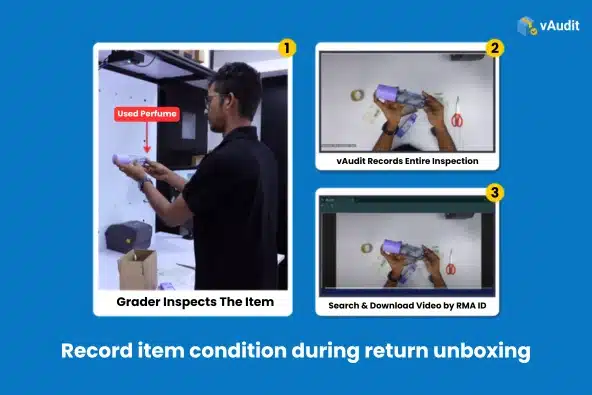
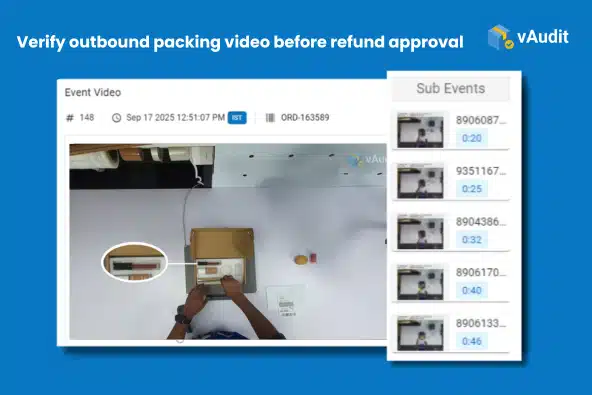
A returns validation video system adds that reference layer. The return is scanned or entered, the system retrieves the original packing session footage, and the associate can compare the two side by side. The verification check covers:
  • Whether the returned item is the same SKU that was originally packed and sent.
  • Whether the condition matches what was recorded at dispatch or shows new damage.
  • Whether all items in a multi-item order have been returned or only part of the order.
  • Whether accessories, inserts, or bundled components are included in the return.
  • Whether the return matches the RMA or return authorisation on file.
vAudit returns validation video system
That comparison is what turns return verification from a visual inspection into a documented review. The decision is still made by the team, but it is made against evidence rather than memory or assumption.

How can packing video proof support refund decisions?
vAudit proof of condition

Packing video proof for refunds supports the decision at the point where it is hardest to make well: when the return looks legitimate on the surface, but something does not add up.

A customer returns an item claiming it was damaged on arrival. The team inspects it and the damage is there. Without outbound footage, the only question is whether to approve. With packing video proof, the team can check whether the item left in that condition or was damaged by the customer after receipt. That distinction directly affects refund eligibility.

The same logic applies to item swaps, missing components, and wrong-item returns. Packing video management gives the returns team a before-state to compare against.

Return claim type Without packing video proof With packing video proof for refunds
Item arrived damaged
Damage is visible on return; team has no outbound reference
Team checks outbound footage to confirm condition at dispatch
Wrong item returned
Associate inspects item; hard to confirm without order history
Original packing footage shows the specific SKU sent
Item swap (empty box or substitute)
No way to verify what was in the original parcel
Outbound recording shows contents before sealing
Partial return (missing components)
Team counts what came back but has no original count reference
Footage shows full order packed including accessories and inserts
Packing video proof for refunds does not make the decision for the team. It gives the team something to base the decision on. That is the difference between a refund policy and a returns validation process.

Still approving refund claims without proof?

Schedule a demo to see how vAudit helps your team compare outbound packing video with returned items before approving refunds.

What is return-linked evidence?

Return-linked evidence is inbound footage that is connected to the specific return under review.
What makes return-linked evidence usable is the connection to the order record. The user retrieves the outbound footage on the returns validation software with the order ID. No manual searching, no digging through a folder of clips, no relying on CCTV timestamps.
The evidence that actually matters when reviewing a return:
  • The original packing footage showing what went into the box and in what condition.
  • The order ID that ties the footage to the specific transaction rather than leaving it as an anonymous clip.
  • Any still images captured mid-session, if the packer documented a specific condition at the time.
  • The return condition recorded at the inspection station. This is what makes the comparison meaningful. Without it, you have the outbound side but nothing to hold it against.
Together, these create the side-by-side return evidence picture: what left versus what came back. Proof of condition captured at dispatch is what makes this comparison meaningful. That is what a returns team actually needs to make a defensible refund decision.

Where does manual returns validation fall short?

Manual returns validation depends on the associate’s judgment, the information available at the time of inspection, and whatever notes or records exist from the original order. In a low-volume environment with a narrow product range, that can work reasonably well.
At scale, the gaps show up quickly:
  • High-volume return periods compress review time per return, making careful visual checks harder to sustain.
  • Item swaps are difficult to catch without a documented record of what was originally sent.
  • Refund abuse patterns are hard to identify without a searchable record linking the return to the outbound packing event.
  • Disputed refund decisions are hard to defend when the basis for the decision is the associate’s visual impression, not documented evidence.
A returns validation video system does not replace the returns associate. It gives them a reference point that makes their judgment more reliable and the decisions they make more defensible.

Return checks still relying on visual judgment alone?

Talk to sales to see how order-linked packing video helps your team validate claims with documented proof.

Where does packing video proof fit in the reverse logistics workflow?

Reverse logistics already has defined stages: the return is initiated, the parcel is received, the contents are inspected, a decision is made, and the refund or replacement is processed. Packing video management plugs into the inspection stage without disrupting the stages around it.
The workflow addition is minimal:
  1. The return parcel is received and the order ID or RMA is scanned.
  2. The user pulls up the outbound packing footage on the returns management software.
  3. The associate checks the return condition with the packing video.
  4. Packing video decides whether this is a valid claim.

The returns management software makes the footage retrieval fast because for operations handling significant return volume, that retrieval speed matters as much as the footage itself.

Where does vAudit fit in your refund claims approval process?

vAudit captures packing video proof at the outbound station and stores it in Forge Cloud, linked to the order ID. When a return comes in, the returns team searches the order number and retrieves the original packing session immediately.
The packing video management layer handles storage, indexing, and access. Footage is retrievable by order ID, shareable as a secure proof link, and exportable as reverse logistics video evidence for returns decisions, chargeback submissions, or compliance records.
For operations that need structured returns verification rather than just retrieval of outbound footage, vAudit HD with display supports guided returns handling workflows. The associate is walked through the verification steps at the station, and the review is captured as RMA video proof tied to the return event.

Need video proof inside your returns workflow?

Schedule a demo to see how vAudit links packing footage and return reviews.

Frequently Asked Questions

What is the difference between returns validation software and a general returns management platform?

A returns management platform handles the mechanics: the RMA, the routing, the refund, updating inventory. It is about processing the return. Returns validation software is about checking whether the return is what it claims to be. It compares the outbound video to the inbound return video and helps the grader verify the SKU and item condition on arrival.
Retrieving packing video proof for refunds before opening the return parcel gives the associate a baseline for what the order looked like when it left. Then the inspection becomes a comparison with the original state rather than a standalone visual judgment.
Yes. The outbound packing footage can be shared as a secure proof link as part of the returns communication. This is particularly useful when denying a claim that the customer is likely to escalate. Showing the customer the outbound recording alongside the documented return condition provides a clear basis for the decision and reduces the likelihood of the dispute progressing further. Some operations use this proactively as part of their returns policy communication for high-value orders.
Peak return periods are exactly when teams need this most. Everyone is moving fast, review time is limited, and the chances of approving something without a proper check go up. A returns validation video system does not slow that down. The associate scans the return, the outbound footage comes up, they compare and make a call. The speed of the process stays the same. What changes is they are making the disposition decision with proof.

Ready to validate refund claims with confidence?

Talk to sales to see how vAudit helps reduce refund abuse, item swaps, and disputed return decisions with video proof.
© All Rights Reserved.