
How Does Video Proof Help Resolve Customer Disputes and Shipping Claims?

Video proof for customer disputes is an order-linked footage from the packing station that shows what was packed, in what quantity, and when, before the parcel shipped. When a customer says an item was missing, the wrong product arrived, or the parcel was damaged, that footage gives the support or operations team something to review rather than a shipment status and a tracking number.
Most operations already have a response process for disputes. The problem is the evidence. Carrier tracking confirms the parcel reached the customer. The WMS confirms the order shipped. Neither confirms what was physically in the box. Such packing video proof fills that gap, and the difference in resolution time and outcome is significant.

How can video proof help resolve customer disputes?

It gives the team a direct answer to the question the customer is asking: Was my item in the box? When you use video proof for customer disputes that question gets answered with evidence rather than estimation.

Without visual proof of order fulfillment, the investigation goes backwards. Support contacts the warehouse. The warehouse checks notes, asks the packer, looks at what they can find. That process is slow, depends on memory, and rarely produces a clear answer. It often ends with an approval or a refund just to close the ticket.

With a timestamped packing video proof, the process is different. The support team searches the order ID, pulls the recording from the packing session, and reviews what was packed before the box was sealed. The answer is either there, or it is not. Either outcome is useful.

You need video proof for customer disputes to satisfy these two pivotal requirements:
  • Verify: Confirming whether the item was packed correctly before approving a refund or replacement.
  • Prove: Showing the customer or platform that the order was fulfilled accurately when the claim is false or unclear.
It also changes the dynamic with the customer. When a support team can say the video proof has been reviewed, the conversation moves faster. Some disputes close immediately. Others that looked straightforward turn out to need closer review. Either way, the team is working from evidence, not assumptions.

What proof is needed for shipping claims?

The answer depends on where the claim is being made and what it is about. Missing item claims, wrong item claims, and shipping damage claims each require slightly different evidence.
Claim type What the claimant needs to see What video proof of shipment provides
Missing item
Evidence the item was packed before shipment
Footage showing the item placed in the box, linked to the order ID
Wrong item sent
Confirmation of which SKU was packed
Recording showing the actual item and label at the time of packing
Damaged in transit
Proof of pre-shipment condition
Footage of the sealed parcel before carrier handoff
Quantity dispute
Count of units packed per order line
Video showing items counted and placed into the box
Marketplace platform dispute
Order-level packing evidence
Claim-ready export or secure proof link for platform submission

Visual proof for order fulfillment matters most when the claim has no other resolution path. A carrier delivers the parcel. The customer says it arrived empty. Without pre-shipment footage, the warehouse has no way to show the item was there when it left. Only a timestamped video proof of shipment condition close that window.

Video proof for shipping claims also needs to be retrievable quickly. A 48-hour dispute window on a marketplace platform does not leave time for manual warehouse searches or internal back-and-forth. Video proof for customer disputes needs to be tied to the order and accessible within seconds, not estimated from CCTV timestamps.

How do you retrieve packing proof by order ID?
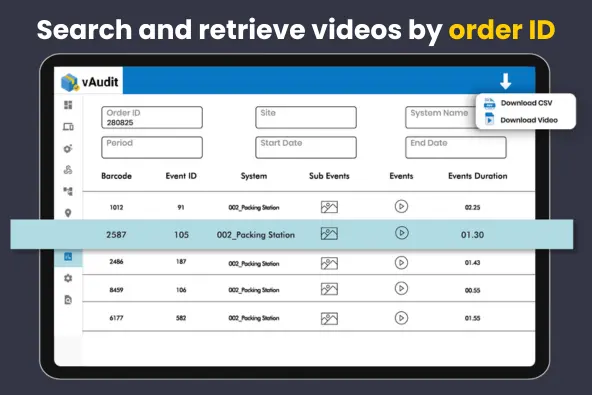
vAudit Video proof for customer disputes
In a system which provides video proof for customer disputes, retrieval is simple. The support or operations team enters the order ID, and the relevant recording appears.
Here is what the retrieval process looks like:
  1. Support receives a dispute or claims for a specific order.
  2. The order ID is entered into the packing video management system.
  3. The system returns the recording of that packing session.
  4. The reviewer confirms what was packed.
  5. If the claim is valid, the resolution moves forward. If it is not, the footage is shared as a secure proof link with the customer or the marketplace depending on the dispute type.
That process works because the footage was linked to the order at the time of recording. Without that link, retrieving video proof for a customer dispute means estimating which camera, which time window, and scrubbing through footage manually. That typically takes more than an hour per dispute. With order ID retrieval, it takes seconds.
The secure proof link is also important. Rather than exporting video files and attaching them to emails or tickets, a share-ready link gives the reviewer control over what is shared and who can access it. That matters when dealing with marketplace proof submissions.

What makes video proof for shipping claims more reliable than photos or manual notes?

A photo of a packed box confirms the box existed. It does not show what went in, in what order, or whether anything was removed or swapped after the photo was taken. Platforms like Whatnot explicitly reject photos as sufficient dispute evidence because they do not show the packing process.
Manual packing notes have the same problem. They record what the packer believed they packed, not what actually happened. In a high-volume environment with dozens or hundreds of orders moving through the same station, notes fail to qualify as packing proof.
When you record video proof for customer disputes, it must capture the packing event. The item in hand. The label. The quantity going into the box and the sealed parcel before it moves to dispatch. A claim-ready export from that footage is timestamped, tied to the order, and shows the sequence of events rather than a static moment.

How does the dispute resolution workflow change with video proof?

The biggest change is where the review happens. Without video proof for customer disputes, resolutions rely largely on internal coordination and policy decisions. With it, they are resolved by reviewing evidence.
The practical workflow shift looks like this:
  • Support receives the claim and searches the order ID instead of forwarding to operations.
  • The review happens in minutes, not days.
  • Valid claims are approved faster because the evidence confirms them.
  • The video shared as a link with the customers end any back-and-forth.
  • QA uses the same footage to identify patterns in errors and close recurring gaps.
That last point is underrated. The video proof is not only useful for resolving customer disputes but also tells operations where things go wrong repeatedly. The dispute resolution workflow becomes part of the quality improvement process rather than a separate cost center.

Why vAudit video proof for customer disputes is now the need of the hour?

vAudit is built to capture visual proof for order fulfillment and make video proof for customer disputes retrievable by order ID. Every packing session is recorded at the station, linked to the order, and stored in Forge Cloud. Support, operations, and QA can retrieve footage by searching the order number, share it via a secure proof link, or export it as claim-ready evidence.
It works alongside the existing WMS and OMS without changing the packing workflow. The packer scans the order to start the session, packs as normal, and the recording is linked to the order ID automatically. No extra steps at the station, no manual tagging.
For businesses dealing with repeated disputes or marketplace compliance pressure, video proof for customer disputes is no longer a nice-to-have. It is the evidence layer that determines whether a claim costs the business money or gets resolved with a clear answer.
Marketplace platforms like Whatnot, Amazon, and eBay have tightened their evidence requirements. Customers know your policies and use it. A missing item claim that gets approved without review gives way for the next one.
At the same time, order volumes have grown. More SKUs, more packers, more stations, more chances for something to go wrong. The warehouse that could manage disputes informally at 200 orders a day cannot do the same at 2,000. Manual notes, verbal confirmation, and general CCTV footage do not scale. They also do not hold up in a formal dispute submission.
Packing video proof closes that gap at the point where it matters most: the packing station, before the parcel leaves the building. The footage is timestamped, tied to the order, and retrievable in under a minute. That is what platforms, payment processors, and customers actually need when a claim is under review.
Operations that implement order-linked video proof now are building a defensible fulfillment process before the next wave of disputes arrives. The ones that wait are still paying the cost of the previous one.

Frequently Asked Questions

How long should packing videos be retained for dispute resolution?

Most customer disputes and shipping claims arrive within 30 to 60 days of shipment. A 75-day minimum retention window covers the majority of cases, including marketplace-specific windows like Whatnot, which requires 75-day retention for seller dispute proof. Operations handling high-value orders or marketplace sales should consider longer retention periods depending on platform requirements and internal audit needs.
Yes. When a buyer disputes a charge through their bank or card network, the seller needs pre-shipment evidence to contest the chargeback. Video proof for customer disputes functions as that evidence. It shows the order was fulfilled correctly before the parcel left the building. The footage can be exported or shared via secure link for submission to the payment processor.
That is up to the business. Video proof for customer disputes can be shared directly via a secure proof link as part of the response, or kept for internal review only. Many operations use it selectively, sharing footage when it supports a denial and keeping it internal when the claim is valid and the refund is being approved. Some premium brands share footage proactively as a trust signal for high-value orders.
Typically as a secure, time-limited proof link rather than a raw video file. This keeps the sharing process clean and controlled. The recipient sees the relevant footage without the business needing to send large files or expose unrelated recordings. For formal dispute submissions to platforms or payment processors, a claim-ready export with timestamp metadata is the standard format.
Yes, and increasingly it is expected. Whatnot explicitly requires sellers to submit video as dispute evidence and retain packing footage for 75 days per order. Amazon and other platforms accept packing evidence as part of claim defense workflows, particularly for SAFE-T claims and A-to-Z guarantee disputes. The footage needs to show the specific order being packed, not a general recording of the station or shift.

Get packing video proof for every order you pack

Record order ID linked packing videos and retrieve it in seconds with vAudit. Resolve costly customer disputes and verify every refund claims before approval with timestamped video proof.
© All Rights Reserved.