What Is Order Processing Video Capture and Why Does It Matter in Fulfillment?

vAudit order fulfillment workflow
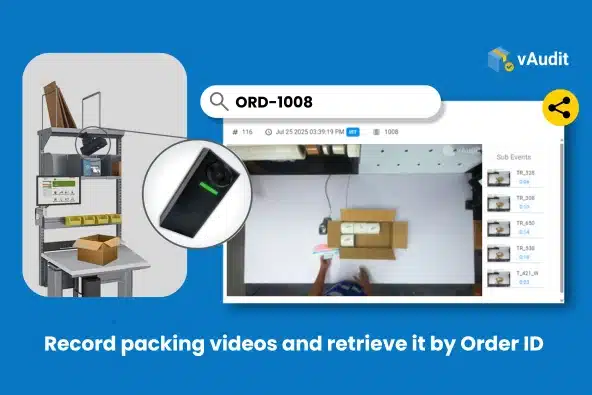
Order processing video capture is the recording of what happens at the packing station during fulfillment, linked automatically to the order ID. It is not a general surveillance feed. The order processing video is stored in a way that makes it searchable and retrievable by any team that needs it later.

Most fulfillment operations have visibility into order movement: the WMS tracks pick completion, the OMS confirms dispatch, the carrier provides tracking. What those systems do not capture is what happened at the station itself. Order processing video capture fills that gap at the packing step, where the physical order is assembled and the order fulfillment workflow reaches its most critical internal checkpoint.
vAudit packstation evidence

What is order processing video capture?

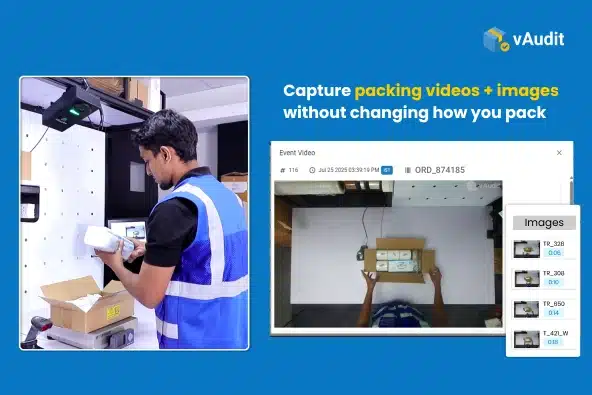
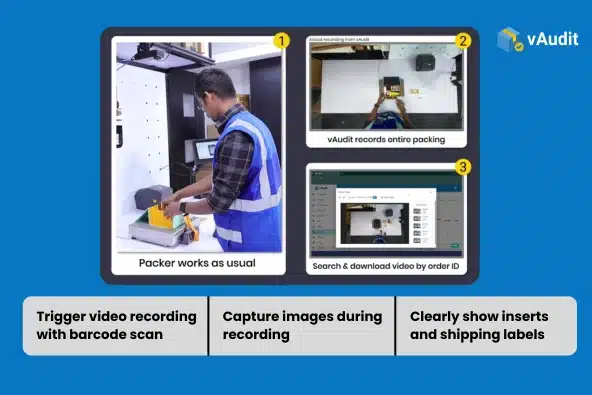
Order processing video capture is a method of recording the packing event during order fulfillment and indexing that footage against the order ID, station, packer, and timestamp. The recording starts when the order is opened or scanned, captures the packing session, and stops when the order is complete.
It is different from a CCTV feed that runs continuously and records everything in a room. Order processing video capture is session-based. Each session is one order. The clip is discrete, tied to that order, and retrievable by searching the order number.

What a fulfillment video recording system captures during a session:

  • The items being placed into the box, with packaging and labels visible.
  • The order on screen, so the packer’s reference is part of the record.
  • Quantity going in, reviewable from the footage after the fact.
  • Any correction or re-pack before sealing.
  • The sealed box before it moves to dispatch, giving pre-shipment condition evidence.
Together this creates order lifecycle proof for the packing step: a documented record of what was in the order at the moment it was assembled and sent.

Can video recording track picking and packing activity?

When buyers search for recording picking and packing, they are usually trying to understand where in the order fulfillment workflow video capture is possible. The picking floor and the packing station are different environments with different constraints.
Recording at the picking floor is technically possible but operationally complex. Pickers move around the warehouse, work across multiple locations, and are not tied to a fixed station. Tracking picking activity with video requires body-worn cameras or zone-based surveillance, neither of which gives you order-linked footage in a practical form.
The packing station is a different situation. A packer works at a fixed bench, processes one order at a time, and scans or opens each order as they start. That workflow is exactly what makes order processing video capture practical. The recording starts with the order, captures a defined event, and stops cleanly. Picking and packing recording, in practical fulfillment deployments, is almost always centered on the packing station.
Stage Video capture practical? How it works
Picking floor
Limited
Requires body cameras or zone surveillance; footage is not order-linked by default
Packing station
Yes
Fixed station, order-based trigger, session tied to order ID automatically
Dispatch / handoff
Possible
Condition proof for carrier handoff; typically a single photo or short clip
Returns station
Yes
Return event recorded and linked to RMA or order ID for comparison

For most operations looking at order fulfillment recording, the packing station is where the investment makes practical sense. It is fixed, order-triggered, and produces footage that is directly linked to the transaction. That is why recording picking and packing, in practice, means recording at the packing station.

Need order-linked proof at the packing station?

Schedule a demo to see how vAudit captures each packing session and links it to the order ID for easy review.

Why does operational visibility across order processing matter?

Because most fulfillment problems are discovered after the order has shipped, and by that point the station event is long gone.
A WMS can tell you the order moved from pick to pack to ship. An OMS can tell you it was dispatched on time. Neither can tell you what was physically placed in the box, whether the packer caught and corrected a mistake, or whether the right variant was used. Those details only exist if something captured them at the time.
Operational visibility at the pack station means having a record of those details before a problem surfaces, not scrambling to find one after a customer complains. The difference shows up in a few specific ways:
  • Disputes get resolved faster because the team is not waiting on information from warehouse investigation. The footage is there.
  • QA reviews become targeted rather than random. Instead of spot checks on arbitrary orders, teams can pull recordings for orders that generated complaints and see exactly what happened.
  • Process problems become visible at their source. If the same type of error keeps appearing in complaints, pack station evidence shows whether it is a training issue, a station layout issue, or an SKU placement issue.
  • New packers can be reviewed without direct supervision during every session. The footage fills that visibility gap during onboarding.
That last point is more practical than it sounds. Most operations cannot have a supervisor watching every packer during every shift. Order processing video capture does not replace supervision, but it means the record is there when a review is needed.

Where does order processing video capture belong in the order lifecycle?

Order processing video capture belong at the packing step, which is the last internal checkpoint before the order leaves the building.
The order lifecycle moves through intake, picking, packing, dispatch, and delivery. Order fulfillment recording that is tied to the order ID is most valuable at the packing step because that is where the physical contents are assembled. Everything that happens before packing is internal preparation. Everything that happens after packing is external.
The packing step is the last moment when a wrong item, a missing component, or a damaged product can be caught and corrected without a customer complaint. It is also the last moment when the condition of the order can be documented before it leaves operational control.
Order stage What happens What order processing video capture adds
Order intake
Order received and entered into system
No direct capture needed at this stage
Picking
Items pulled from warehouse locations
Limited; picking is not a fixed-station event
Packing
Items assembled and boxed for dispatch
Core capture point: session tied to order ID, items and condition documented
Dispatch
Parcel handed to carrier
Optional: pre-handoff condition clip useful for carrier accountability
Understanding where order processing video capture sits makes it easier to explain its value accurately. It is not a full-order-lifecycle tracking system. Order processing video capture is pack station evidence covering the most critical internal checkpoint in the fulfillment workflow.

Missing visibility at your last internal checkpoint?

Talk to sales to see how vAudit gives your team pack station evidence before the order leaves the warehouse.

Who uses order processing video capture and for what?

The packer does not need to interact with the footage at all. The recording runs in the background. The teams that use order processing video capture are the ones that need pack station evidence after the order has shipped.
In practice, access to order fulfillment recording is used by several teams, each for different reasons:
  • Customer support pulls recordings when a customer reports a missing or incorrect item. The footage shows what was packed before the box was sealed.
  • Operations use recordings to identify if packing errors follow patterns across specific SKUs or order types.
  • Finance teams reference pack station evidence when evaluating chargeback claims.
  • Account managers at 3PLs use footage when a brand client raises a fulfillment accuracy question. Being able to show order-level evidence rather than only a shipment status changes the conversation.
  • Compliance teams use recorded sessions during internal or client-requested audits where documented proof of process execution is required.
The fulfillment video recording system handles storage and indexing. Each of these teams searches by order ID and retrieves the relevant session. Nobody needs to know which camera or which shift. The order number is the access point.

Where does vAudit fit in?

vAudit is a fulfillment video recording system that handles order processing video capture at the packing station. The packer scans the order ID to start the session. The recording runs while they pack. When the order is sealed, the clip is pushed to Forge Cloud, indexed against the order ID, and available immediately for retrieval.
Two hardware configurations support different station models. vAudit Desk runs on an existing desktop with a USB webcam, making it straightforward to deploy without new hardware. vAudit HD is a purpose-built station for operations that want dedicated hardware, with barcode-triggered and API-driven recording for integration with WMS, OMS, and ERP systems.
Both feed into Forge Cloud, where order fulfillment recordings are stored and accessible across teams. From there, footage can be searched by order ID, shared as a proof link, or exported when a dispute, audit, or client review needs it.

Ready to make every packed order searchable?

Schedule a demo to see how vAudit stores packing videos in Forge Cloud and makes them searchable by order ID.

Frequently Asked Questions

Does order processing video capture require changes to the existing OMS or WMS?

Not for basic deployment. A software-led setup uses the existing packing screen or barcode scanner as the trigger, so the OMS or WMS does not need to be modified. For operations that want the OMS or WMS to control recording start and stop directly, API-driven integration is available through vAudit HD. That approach gives the existing system full control over when recording begins and ends, but it requires an integration build rather than a simple setup.
Yes. Each station runs as an independent session and pushes footage to a shared cloud environment. Operations managers can pull recordings by order ID.
The system records and uploads sessions regardless of order volume. Peak periods do not degrade recording quality or trigger any manual steps for the packer. The main consideration at peak volume is trigger reliability: if the recording is triggered by a barcode scan, packers need to maintain their scan discipline even when processing orders quickly. API-driven or OMS-triggered recording removes that dependency entirely since the system manages the trigger rather than the packer.
Most footage is never reviewed. It exists as a record and is only accessed when something requires investigation. The most common review triggers are a customer dispute, an internal QA audit, a chargeback investigation, or a client query at a 3PL. Reviews are usually kicked off by customer support, operations, finance, or account management depending on what triggered the query. Packers are rarely involved unless the footage is being used for a training conversation.
It can contribute to it. When a brand client questions whether a specific order was fulfilled correctly and on time, order lifecycle proof from the packing session gives the 3PL something concrete to reference. It does not replace SLA reporting tools, but it strengthens the 3PL’s position when a client dispute turns on what happened at the station rather than what the system shows. Some 3PLs use this as a differentiator: the ability to show order-level pack station evidence is increasingly a commercial argument in client conversations about fulfillment quality.

Want proof that no one cany deny in your fulfillment?

Talk to sales to see how vAudit helps support, operations, finance, and 3PL teams resolve order questions with video evidence.
© All Rights Reserved.