Case Study Summary
Who is the operation?
A high-volume third-party fulfillment operation managing daily inbound receiving and outbound shipping for multiple clients, where disputes directly affect chargebacks, trust, and margins.
What problem kept coming up?
When questions arose after shipping or receiving, teams could see records in the system but had no proof of what physically happened at the packing table or receiving dock.
Why were disputes hard to close?
Shipping records showed labels, not contents. Receiving records showed counts, not what actually arrived or its condition.
What changed after vAudit was added?
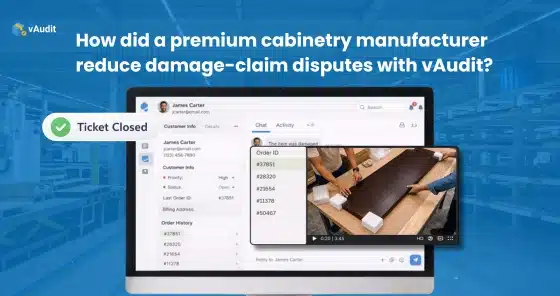
vAudit recorded packing and receiving activity and tied each recording to the same IDs already used by the operation, creating clear proof without changing how teams worked.
What was actually going wrong on the warehouse floor?
A client would question a shipment. A carrier would push back on a claim. Someone would ask whether an item was missing, short, or damaged. At that point, teams went looking for answers and found the same limitation every time.
The system could say an action was completed. It could not show what physically happened. That gap turned routine questions into time-consuming investigations.
Why did shipping disputes take so long to resolve?
On the shipping side, every package left the building with a label and a package ID. That part worked.
What was missing was visibility into the box itself.
When a dispute came in, teams could confirm:
- A package ID existed
- A label was printed
- A shipment was marked complete
What they could not confirm was:
- What items were actually placed in the box
- Whether quantities matched the order
- Whether anything was missing at pack-out
Without visual proof from the packing moment, teams were left comparing records and relying on recollection. That slowed resolution and increased the likelihood of chargebacks.
Why was receiving even harder to verify?
Receiving had a different challenge.
Inbound goods were not barcode-driven. Items arrived, counts were recorded, and transactions were logged. But once the pallet moved on, there was no record showing what physically arrived or what condition it was in.
When a client later questioned:
- Short shipments
- Damaged items
- Incorrect quantities
The team had no way to point back to the moment of receipt. Investigations relied on notes, timestamps, and assumptions.
That uncertainty added friction on both sides.
What did the operation need instead of more process?
The answer wasn’t more checks. It wasn’t manual audits. And it definitely wasn’t slowing the floor down.
What the team needed was simple:
- Proof of what was packed into each outbound box
- Proof of what arrived during inbound receiving
- Evidence tied to the same references already used in daily work
Most importantly, it had to happen without changing how people worked.
How was vAudit added without changing daily workflows?
vAudit was installed in two places:
- At the packing stations
- At the receiving area
No new steps were introduced. No retraining of the core process.
Recording started and stopped based on identifiers the team already used. That decision kept adoption smooth and avoided resistance from the floor.
How did vAudit document outbound packing?
At shipping, the package ID became the anchor.
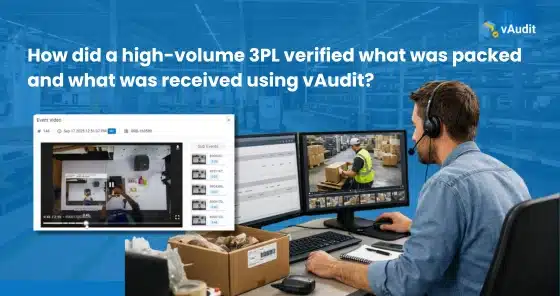
Once a label was generated, vAudit recorded the packing process and linked the video to that package reference. When questions came up later, teams searched using the same ID they already relied on and pulled the exact footage.
The recording showed:
- What items went into the box
- Whether counts were correct
- The final state of the package before it left
That changed the nature of shipping disputes. Conversations moved from “what should have happened” to “here’s what happened.”
How did vAudit document inbound receiving without barcodes?
The warehouse associate at the receiving station scanned the transaction ID to trigger recording. Each inbound receipt now had visual documentation showing what arrived and how it looked at the time of receipt.
This made it possible to confirm:
- Actual quantities received
- Visible condition at arrival
- Whether discrepancies existed at the dock or later
All without asking receiving teams to work differently.
What did the documented workflows look like in practice?
| Area | What was recorded | What questions it answered |
|---|---|---|
|
Receiving |
Items at dock during intake |
What arrived and in what condition |
|
Shipping |
Items placed into outbound boxes |
What was packed and whether it was complete |
The coverage was narrow by design. It focused only on the moments where disputes actually originate.
What changed once vAudit was in regular use?
Disputes stopped dragging on. Instead of pulling reports and looping in multiple teams, the relevant video was reviewed and decisions were made quickly. Some claims were accepted faster. Others were confidently challenged.
Over time, when teams know actions are visible, accuracy improves naturally. Packing mistakes dropped. Receiving discrepancies became easier to catch early.
The operation didn’t slow down. It stabilized.
Why does this approach matter for other fulfillment operations?
This case shows that improving transparency does not require automation overhauls or system replacement. vAudit makes it easier for 3PLs to instantly find the proof and share it with their customers to close a dispute fast or validate claims.
For fulfillment operations dealing with higher volumes and recurring disputes, this approach offers a practical way to protect margins and credibility while keeping workflows intact.