
What is returns fraud and how does it show up in ecommerce workflows?
How much money do retailers lose because of return scams?
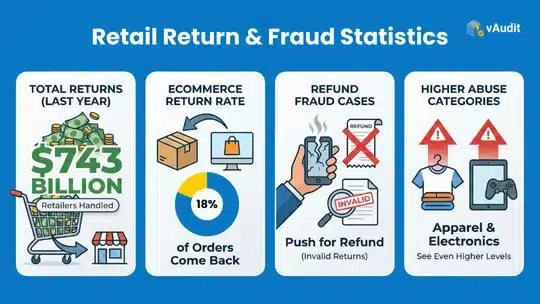
- Retailers handled $743 billion in returns last year.
- Nearly 18% of ecommerce orders come back.
- A part of those cases involve refund fraud, where customers push for a refund even when the return is not valid.
- Some categories, like apparel and electronics, see even higher abuse levels.
What kinds of losses does returns fraud create?
| Cost Area | What Happens? | Impact |
|---|---|---|
|
Refund Losses |
Money paid for fake returns |
5–15% of returns |
|
Return Shipping |
Sending items back and forth |
$8–18 per box |
|
Labor Time |
Inspections and dispute checks |
5–10 minutes each |
|
Inventory Loss |
Items unsellable after fraud |
30–70% write-off |
|
Support Load |
More refund questions and claims |
Up to 25% jump |
|
Slowdowns |
Peak-season bottlenecks |
5–20% lower throughput |
Which return scams show up most in ecommerce fulfillment?
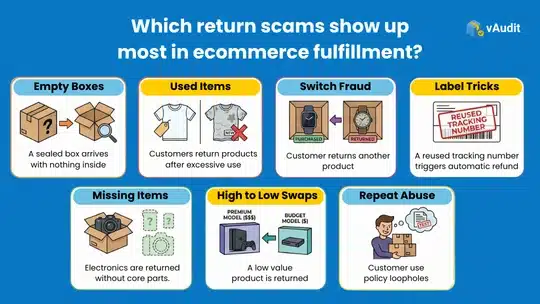
Empty boxes: A sealed box arrives with nothing inside.
Used items: This type of return scams happen often in apparel. Customers wear or use products, then return them as new.
Switch fraud: A customer sends back their old item instead of the one they bought.
Label tricks: A reused tracking number triggers an automatic refund.
Missing components: Electronics are returned without core parts.
High-to-low swaps: A cheaper model is returned in place of an expensive model.
Repeat abuse: Some customers test policies again and again until they meet resistance.
Why does returns fraud spike during holiday seasons?
- Return stations fall behind
- Less documentation gets captured
- More refunds are issued before a full review
- High-value orders increase
- Support teams get overloaded
Why is returns fraud detection so hard for warehouses?
- No visual proof of how the item looked when the return arrived
- Different inspectors follow different steps
- Serial numbers aren’t always checked
- Box weight may look close enough
- Claims don’t match the condition
- No system flags unusual patterns
- Not enough time to document everything
How to detect fraudulent claims at the returns station?
- Recording the unboxing
- Taking still photos during inspection
- Comparing item weight to expected SKU weight
- Checking serial numbers
- Scanning SKUs
- Checking for tampering
- Making notes of anything unusual
- Using a basic grading checklist
What should team review after the return is processed?
- Which claims don’t match the product
- Frequent questionable returns from the same buyer
- SKUs that attract more problems
- Gaps in current policy
How does vAudit support return inspections and fraud control?
vAudit is an ecommerce video logging system that records every return as it’s opened. A camera sits above the returns bench and captures the entire returns inspection process. If the grader finds any stains, tears, or damage, they point it out on the camera and take still images.
- Inspectors open the parcel under the camera
- vAudit records everything automatically
- Still images are captured during the inspection
- Teams can search by RMA ID and pull the video in seconds
How does this help reduce retail return fraud?
- Real proof of item condition at arrival
- Strong evidence for any refund fraud disputes
- Consistent inspection steps
- Alerts for mismatched SKUs
- Faster support tickets
- Cleaner insurance claims
- Insights into patterns across stations or sites
How can retailers build a zero leakage returns flow?
- Write a clear inspection SOP
- Capture video for every return
- Compare claims to actual condition
- Trigger alerts for mismatches
- Track behavior across customers
- Adjust policies based on patterns
Keep your ecommerce returns process safe from returns fraud with video proof
Tools like vAudit give return teams the proof, structure, and speed needed to make the entire process stronger without slowing down the operation.