How did a high-volume ecommerce operation verify orders using weight validation with Packchain and vAudit?

Case Study Summary

Who is the customer?

A large-scale fulfillment operation supporting a global consumer goods brand, running robotic picking and manual packing with strict requirements around order accuracy and verification.

What was actually happening at the pack station?

Orders were packed manually after robotic picks, but verification relied on static item master data. Weight mismatches frequently occurred during packing, even when the physical order was correct.

Why was order verification breaking down?

SKU weight data was often outdated or incomplete. As a result, valid orders failed weight checks, forcing unnecessary manual handling and re-verification.

What changed once Packchain and vAudit were implemented together?

Packchain introduced real-time order verification using weight validation, with vAudit capturing visual proof on the Main Line and supporting controlled manual verification on the Hospital Line.

At high order volumes, verification has to be fast, precise, and embedded directly into the workflow. This fulfillment operation supports a global consumer goods brand with a wide SKU mix, robotic picking, and manual packing. Every order needs to be verified before it leaves the facility, without slowing throughput or adding manual audits.
This case study explains how Packchain implemented order verification using real-time weight validation, supported by vAudit on both the Main Line and the Hospital Line, to ensure accuracy, maintain data integrity, and keep verification inside live packing operations.

Why does weight-based order verification become fragile at scale?

Weight validation is fast. It works well when item data is accurate. But as SKU counts grow and packaging changes over time, that data drifts.
In this operation, verification failures were not always caused by packing errors. Often, the system expectation itself was wrong. When that happens repeatedly, verification stops being reliable and starts creating noise.
The challenge was not adding more checks. It was making weight validation trustworthy again.

How did Packchain anchor order verification inside the workflow?

Packchain already controlled order orchestration.
Before an order reached the pack station, Packchain knew what the order should contain and what it should weigh. The issue was deciding what to do when reality didn’t match expectation.
Instead of pushing every mismatch into manual handling, Packchain was configured to verify, correct, and retry inside the same flow.
That decision changed everything.

How did the main line use weight validation to verify orders?

On the Main Line, speed mattered. Orders arrived from robotic picking and were packed manually.
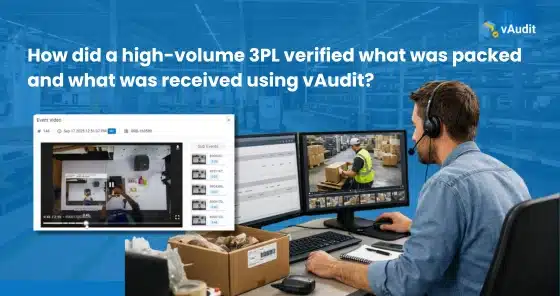
Once packing was complete, the parcel passed under the vAudit setup and was weighed. Packchain compared the actual weight with the expected weight immediately.
When the weight fell within tolerance, the order was verified. vAudit captured an image of the open box at that moment, and the order moved forward without interruption.
Verification happened without adding a step.

Why didn’t a failed weight check always indicate a packing error?

Early on, the team realized something important. A failed weight check did not automatically mean the wrong item was packed.
Failures were often caused by:
  • SKU weight data that hadn’t been updated
  • Newly introduced SKUs without complete data
  • Packaging changes that hadn’t been reflected upstream
Treating these as packing errors slowed verification and sent too many orders for review.

How did Packchain correct SKU data when weight validation failed?

When an order failed weight validation on the Main Line, it did not immediately move to exception handling.
Instead, accurate SKU data was captured inline with vMeasure dimensioning system. That data was sent back to Packchain, which updated or created the SKU master record. The order was then revalidated using the corrected data.
Bad data was fixed at the moment it caused friction. Not later. Not in a report.
Over time, weight validation stabilized because the item master kept getting cleaner.

What happened when an order still could not be verified?

Some orders still required manual verification. These were routed to the Hospital Line.
Here, Packchain remained the source of truth. vAudit supported controlled verification.
The packer scanned the order ID. vAudit pulled the full expected order from Packchain. Each SKU and quantity was checked against the physical items. Any differences were updated during the process and images are taken to show the excess or deficit quantity.

How did visual proof change the way verification was closed?

The impact wasn’t subtle.

Before this setup, verification failures often lingered. Teams debated what might have happened.
After deployment, verification closed faster because there was shared proof captured during packing. Decisions were no longer based on assumption. They were based on what was visible at the time verification occurred. That reduced rework and removed uncertainty.

What changed once order verification stabilized?

Once Packchain, weight validation, and vAudit were fully embedded, the impact was clear.
Area Outcome
Orders routed to the Hospital Line
22% → 0%
Weight-based verification reliability
Restored
SKU master data quality
Continuously corrected
Carton SKUs
Reduced from 20 to 6
Robot pick and pack productivity
Increased
Inventory accuracy
Verified during packing
These results came from better decisions at the right moment, not from adding more checks.

Why did this approach work in practice?

Verification was no longer a separate activity.
It happened while the order was being packed, using weight as the primary signal. Data correction happened immediately when needed. Visual proof was captured only where it added value.
Packchain owned the workflow. vAudit supported verification where physical confirmation was required.

What can other high-volume operations take from this?

If your operation relies on weight validation, the real question is not whether weight checks fail.
It’s whether your system knows what to do when they fail.
This case shows how Packchain can verify orders using weight validation at scale, with vAudit supporting both automated and manual verification paths, without slowing fulfillment.

How would this work in your facility?

If recurring weight mismatches are forcing manual handling or slowing verification, the next step is understanding how vAudit would map into your live workflow.
Order verification does not need to be a separate process. It can live inside packing. Talk to the vAudit sales team today.

Table Of Contents

Any Questions About vAudit?
Resolve Fulfillment Disputes In Seconds.
© All Rights Reserved.